
From the Archives: Driving Lindsey Graham Through a Blizzard in 2015
Graham's passing is a reminder of how much has changed over the past decade

**Weekly updates will return this week after a month-long hiatus.**
Sen. Lindsey Graham died Saturday evening at 71 years old, without any advance notice, of a “brief and sudden illness.”
He was a colorful and entertaining figure, a politician through and through, for better and for worse. He will be remembered for a few things: perhaps most for his move from staunch ally of John McCain to an acolyte of Donald Trump, who trashed McCain during the 2016 campaign for being captured by Vietnamese soldiers when McCain’s U.S. Navy jet was shot down during the U.S. war in Vietnam.
McCain spent 5 1/2 years as a prisoner of war. You can read his first-person account of his capture and imprisonment and torture here.
In 2015, Trump was criticizing McCain during an interview on stage in front of voters when the interviewer called McCain a “war hero.”
“He’s not a war hero,” Trump said. “He is a war hero because he was captured. I like people who weren’t captured.”
Graham stood by McCain at that time, but after Trump took control of the GOP Graham gradually became one of the new populist president’s fiercest advocates in the Republican party, especially after McCain died in 2018 at age 81 from brain cancer.
Graham again broke with Trump in 2021 after the January 6 attack on the U.S. Capitol but again returned to his team after the ex-president in exile re-consolidated control over the GOP.
Just over a decade ago, I followed Graham around New Hampshire and wrote a long profile about the South Carolina Republican’s long shot run for president.
You can read the whole piece here or here. But I’ll paste two passages here:
the introduction about our adventure through a sudden blizzard
a sample of his interactions with Republican primary voters about immigration policy.
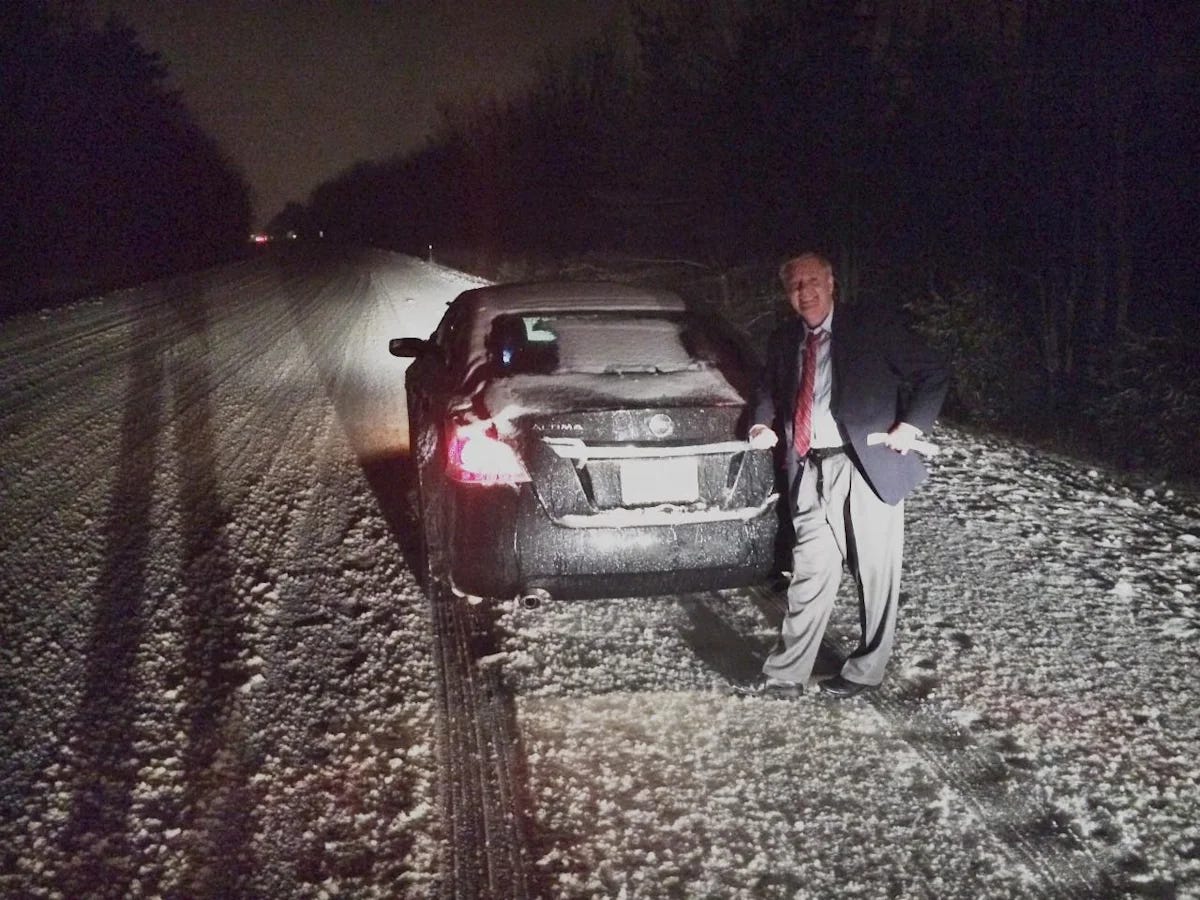
BELMONT, N.H. — I could see the headlines in my mind: “U.S. senator injured when journalist drives off the road.”
Sen. Lindsey Graham (R-S.C.) had just finished speaking to a gathering of local Republicans at the Top of the Town restaurant here, exiting into a near-blizzard.
He took a picture with a local Republican official to document the early April snowstorm — “Nobody back home is going to believe this,” he cracked — then announced to his two aides that he would be driving back to Concord with me, the lone journalist accompanying him that day.
An hourlong trip south on a completely dark, near-empty and snow-covered Interstate 93 followed. Flakes whipping down toward the windshield, I kept my speed at about 35 miles per hour. Any faster and the Nissan Altima started to fishtail.
Eventually we pulled up behind a car going even slower.
“Should I go around?” I asked the senator. I edged the car over to the left to see if it was doable or if the snow on the road was too thick outside of the one lane both cars were forging down the highway.
“Go for it,” said Graham.
The storm had caught the state by surprise. Graham made an occasional remark about the absurdity of driving in such snowy conditions, but mainly he didn’t seem too bothered by them.
We didn’t see a plow for the entire trip. But we did see a car that had slid off the right side of the road into a ditch, hitting some trees at the bottom of a small hill.
We pulled over and got out to see if the driver was OK. Her door was open, and an off-duty cop who had pulled over a few minutes before us in his pickup truck was standing next to her.
“Is everybody all right?” Graham hollered. The young police officer said the driver was not injured and had called AAA. A tow truck was on its way. Graham noticed the badge on his belt and told the officer, “Thanks for taking care of her.”
As we walked back to the car, I pulled out my iPhone to take a picture of Graham and the car and the snow-covered Interstate. With the preternatural instincts of a politician facing a camera, Graham turned and put his right elbow on the car and posed for a picture.
And here’s the interaction with voters on immigration:
Graham was just reelected to a third term last fall, in a deep red state, while talking often about the need for a path to citizenship for illegal immigrants and for greater U.S. military involvement in the Middle East.
Graham’s down-home drawl and off-center wit are a sugary coating that he uses to disarm audiences so that he can dispense some very unwelcome realities to the Republican party’s most conservative voters, particularly on immigration.
The confrontation that Graham is seeking on this issue often comes to him, as it did here during his appearance in Belmont at the biweekly dinner of the Belknap County Republican Committee, when a man with a mustache and a short ponytail, wearing a suit and tie, rose and challenged Graham from the back of the main dining room.
“Didn’t you kind of support amnesty for illegal aliens at one point?” said Raymond Howard Jr. Howard — who last fall was elected to New Hampshire’s 400-member state House and who told me later that he thought Wisconsin Gov. Scott Walker was acceptable but that Donald Trump was “what we really need” — asserted to Graham that undocumented immigrants were getting taxpayer-funded benefits “they never earned.”
Graham pounced. “This is a great question,” he said. He immediately contradicted Howard’s statement that illegal immigrants can receive government benefits, but then ran the audience through a series of questions and answers.
“Paying these guys under the table hurts every worker in America. Do you agree?” he said. There were a handful of yeses.
“All right. Do you agree that having a porous border allows somebody to come in to the country to blow us up?” he said.
“Yup,” someone said.
“Do you agree that having 11 million people living in the shadows is not good for our culture?” Graham inquired. This time there was a muted response.
“Do you agree that they’re here mostly to work?”
He was met with several emphatic noes, but forged ahead, using his background as an Air Force lawyer to lead the crowd like a witness in a trial.
“Why are they here?” he said.
“For the freebies,” a woman said. “Freebies,” a man echoed.
Graham sounded slightly exasperated. “Well, they — that’s wrong, absolutely,” he said.
Howard spoke up from the back of the room.
“I can tell you some in this state that are illegal aliens and are signed up and getting benefits,” said the 62-year-old state rep.
“You can say that, but there is no — you cannot get food stamps, you can’t get Medicare, you can’t get Social Security if you’re illegal,” Graham said and then went beyond defending illegal immigrants to advocating for them. “About $80 billion has been paid into the Social Security system by illegal immigrants, and they’re never going to get the money out. They’ve been paying in, but they’re not going to get it out.”
This went on for almost 15 minutes, with Graham challenging his listeners, then letting out some pressure with a joke, and then charging back into another rapid-fire series of queries.
“As to the 11 million, crooks are not welcome. Do you agree?” General nods of assent.
“How many of you think they all should be driven out of the country?” Howard raised his hand, along with a few others.
“How many of you think that that’s pretty much hard to do?” Several hands shot up.
“How many of you think that some of them can stay but they gotta learn English?” Several hands went up again, probably responding more to the clause on the back end of that sentence than the one on the front end. “Gotta learn English,” one man said.
“I don’t speak it well, but look at how well I turned out,” Graham cracked, getting a few laughs.
And on and on. “How many of you believe they should get paid over the table, not under the table?”
“Pay taxes?”
“How many of you think they should pay a fine?”
“How many of you think they should not be able to cut in line in front of somebody who’s been waiting years to get here?” There were murmurs of agreement. “Exactly,” a man said.
Graham had gotten the crowd to agree to the basics of the bill that the Senate passed in 2013. “Now we’re talking,” he said, quietly pleased with them, and with himself.
This was April 2015. At that time, Donald Trump was an afterthought to most. The idea of him even coming close to winning the Republican nomination for president, in a primary with Jeb Bush, Marco Rubio, John Kasich, Chris Christie, Ted Cruz and others was a punchline. But not to voters like the one who said in this scene with Graham that Trump was “what we really need.”
It turned out there were enough of these Trump voters in 2016 — about a third of the Republican party’s primary voters at the time — to give Trump the nomination when the other Republicans couldn’t consolidate around a consensus choice who appealed to the other two thirds of the party.
That watershed event threw remarks like Graham’s at the end of this piece back in his face.
Rubio, Graham said, was “so afraid of the right.”
“I’ve let that go,” he claimed.
Thank you for humanizing him. I feel like if we were able to have real conversations with all kinds of politicians we'd be able to get past some of this divisive rhetoric and start to gain some consensus in some areas.